

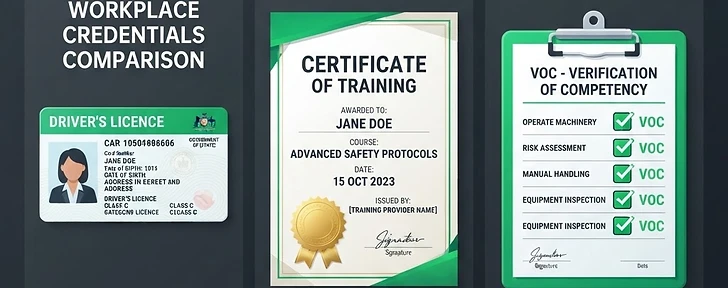
If you work in construction, mining, or any industry that uses heavy plant, you've probably heard the terms licence, ticket, and VOC used almost interchangeably. They're not the same thing — and understanding the difference matters for both workers and employers.
Licence
A licence is a government-issued authorisation to operate a class of high-risk equipment — for example, a forklift, crane, or boom lift. In Australia, these are issued by the relevant regulator (such as SafeWork or WorkSafe) and are a legal requirement for the equipment they cover.
A licence proves you were once assessed as competent. It does not prove you are still competent today, or that you can operate a specific make and model on a specific site.
Ticket
A ticket usually refers to a competency-based qualification issued by a registered training organisation (RTO) — for example, a statement of attainment for operating a skid steer or excavator. Tickets are often a prerequisite for a licence or for site access.
Like a licence, a ticket demonstrates past training, not current ability.
Verification of Competency (VOC)
A VOC is a current, practical assessment of whether a worker can safely operate a specific piece of equipment right now. It bridges the gap between a licence or ticket and the real demands of a worksite.
A VOC typically confirms:
- The worker's licence or ticket is current and relevant
- The worker can operate the specific machine safely
- The worker understands site-specific hazards and procedures
Which do you need?
In most cases, all three work together: a licence or ticket gets you in the door, and a VOC confirms you're safe and competent on the actual equipment you'll be using. That's why an increasing number of employers and principal contractors require a current VOC before allowing work to begin.